Digital Curation as Multimodal Thinking
Leah Duncan | February 10, 2026
I first heard the phrase “digital humanities” when a few of my grad student peers began contributing to Digital Dubliners, a digital edition of Joyce’s novel spearheaded by Joseph Nugent at Boston College. With archetypal 20-something wisdom, I brushed it off as a flashy project that seemed disconnected from the type of deep reading and thinking I was in school to pursue.
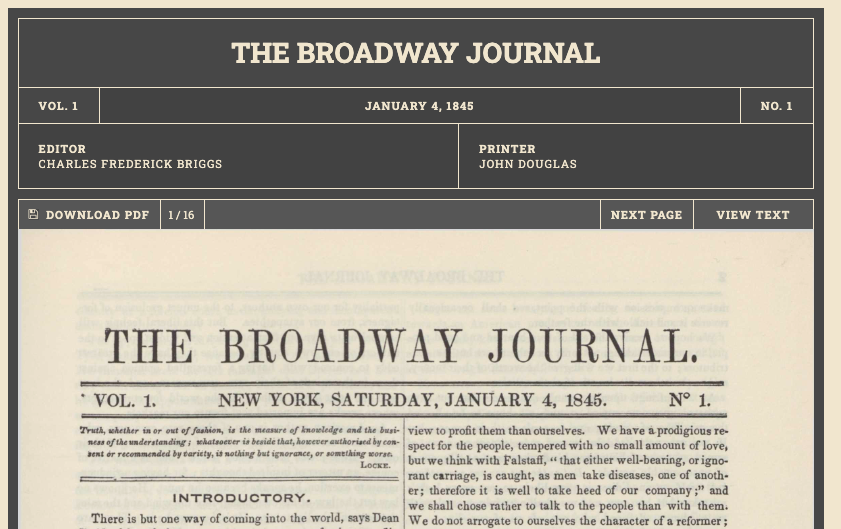
A few years later, the library at LSU provided me the opportunity to help create a data-rich edition of the Broadway Journal, a literary periodical edited by Edgar Allan Poe. Since my research was focused on 19th century U.S. print culture, the journal itself attracted me to the project. However, when I realized the research potential enabled by the interdisciplinary digital methods we were using, I knew I had found the type of work I wanted to keep doing, with or without Poe.
Roughly ten years later, I have the privilege of facilitating innovative and interdisciplinary digital projects as the Digital Humanities Librarian at Davidson College.
I experienced a highlight of that type of innovative work last year, when Yukina Zhang invited me to help students in “Art Along the Silk Roads” use Omeka to create digital collections and exhibits of rhyton (horn-shaped vessels) and cobalt-decorated objects traded along the Silk Road.
I led an early class session in which I helped students understand the function of metadata in enabling researchers to discover useful sources in digital collections of cultural heritage materials. To illustrate the point, students searched digital collections to find answers to questions that depended on high-quality descriptive information. Next, students considered the objects they would describe in their own collections, and collaboratively selected the metadata fields that would be most meaningful for future users: for example, “subject,” “date,” and “format.” Finally, students worked together to develop guidelines for their descriptive metadata, understanding that if one person writes the date as “13th Century CE,” and another writes “c. 1250 CE,” future researchers will be less likely to find relevant information related to 13th century objects. With a solid grasp on the information they would connect to their curated objects and the standards they would use to record that information, students were able to begin curating their collections.
In a later class session, I helped them use their collections to create digital exhibits. Their exhibits highlight key items and provide interpretive content, walking users through focused histories of “Arts Along the Silk Roads” as illustrated by the art objects they curated.
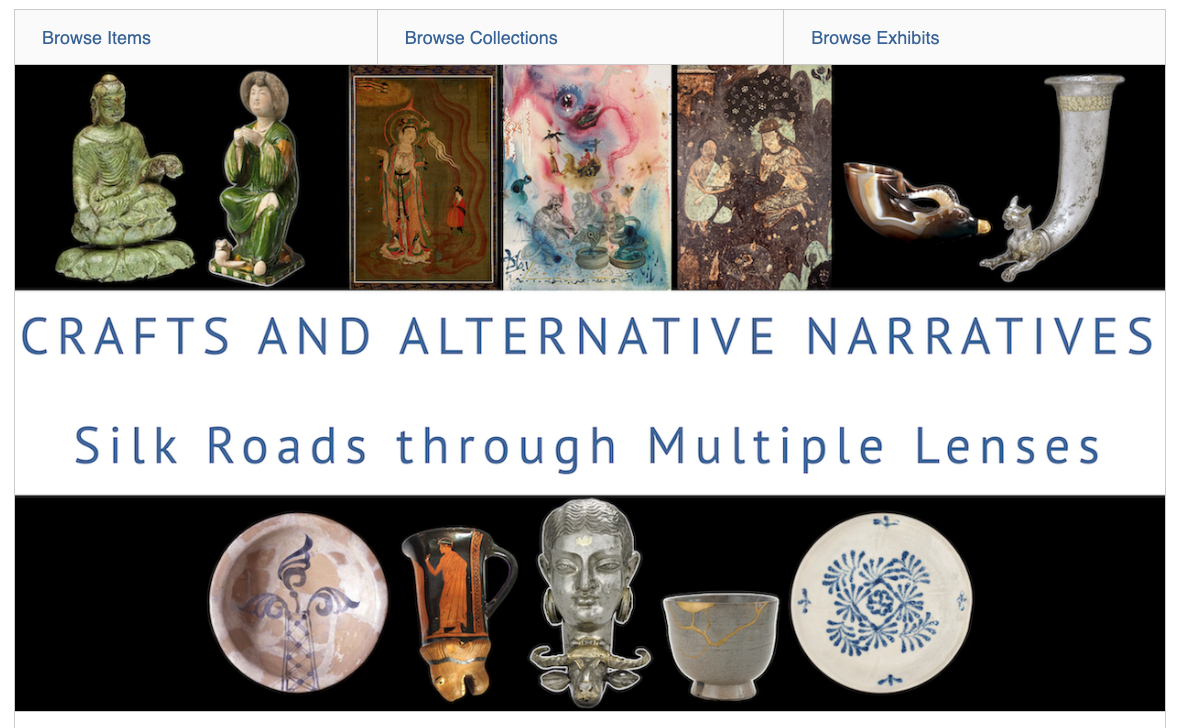
This project is an example of the type of work I love to facilitate because it leveraged digital tools (in this case, Omeka) to foster ways of thinking that traditional research papers do not usually require. Students learned that curation is a rhetorical task, and they participated in that task by making decisions about the objects that would allow them to tell their stories. They learned about the organization of information by making collaborative decisions about the descriptive metadata they would record. Finally, they synthesized their curatorial and descriptive work into interpretive exhibits that presented detailed analyses of (digitized) material objects. View the final “Art Along the Silk Roads” project here.
I love the process of building digital collections and exhibits, but other digital humanities projects require similar degrees of critical and creative thinking. Students using TimelineJS to present information in a media-rich chronology must consider the historical events that define their topic and the visuals that impactfully illustrate those events. Students engaging in computational text analysis must think deeply about the types of questions textual data can answer and develop methods for visualizing that data. Students presenting a policy paper on a website for the general public must design a user interface that guides a non-academic audience in understanding their recommendations. If you’re interested in thinking more about this type of research and learning, I invite you to reach out to the Digital Learning & Scholarship team at digitallearning@davidson.edu.